AI Content Studio
Hyperlocalized creatives for automobile dealers
Brands push the same creative to 500 plus dealers. Every dealer has a different city, buyer profile, and campaign need. This app tests the engine that generates dealer-specific social media creatives so a Diwali EMI post for a Pune dealer feels nothing like one for Ludhiana.
Hosted on Railway
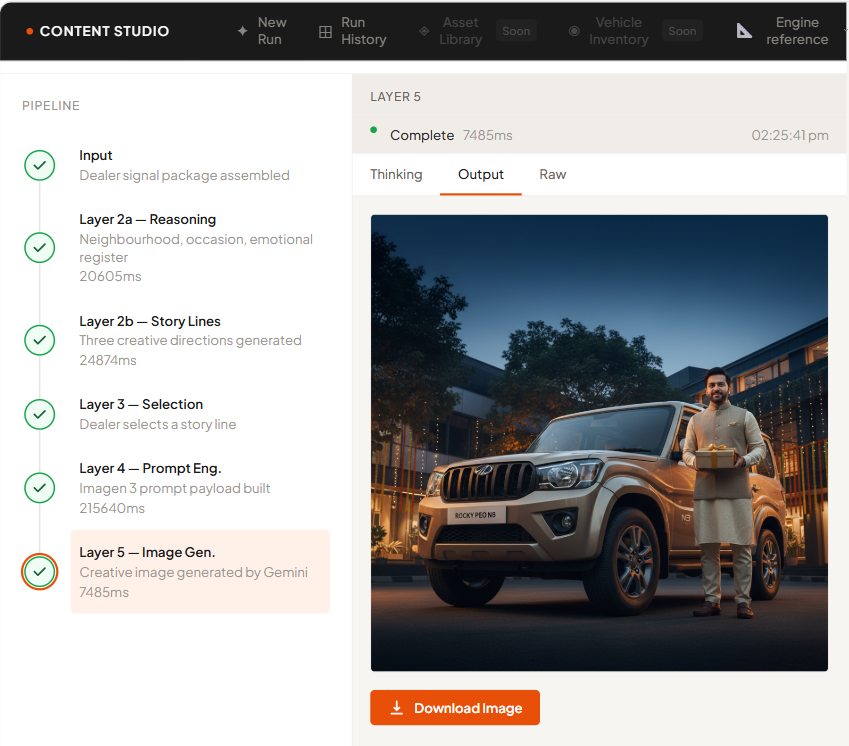
Pipeline run completing Layer 5 image generation
Brand creatives don't localise themselves
In automobile retail, marketing flows top-down from brand to dealer. What arrives is polished, on-brand, and completely context-free.
Brand Side
Central teams produce high-quality campaign creatives for the whole network. One Diwali post. One EMI banner. Designed to work everywhere, which means optimised for nowhere.
Dealer Side
A dealer in Nagpur running a Thar EMI offer speaks to a different buyer than one in Gurugram promoting a test drive. Generic brand creatives do not speak to the local context.
The Gap
No hyperlocalization. No occasion-specific framing. No variety across 500 plus dealers. The creative looks like it belongs to the brand, not to the dealership.
The Hypothesis
If a dealer can describe their context in structured inputs, a generative AI pipeline can produce a creative brief and image specific to them, at scale, without a design team.
Why this needed AI
CONTEXT
Every dealer input is a unique combination
City, occasion, vehicle, buyer intent. No two dealers are the same.
Contextual reasoningBRAND CONSISTENCY
All creatives stay within brand guidelines
Dealer-specific does not mean off-brand. The engine works within guardrails set by the brand.
Brand-safe outputREASONING FIRST
Understanding context before generating
The model reasons about the dealer's situation before producing anything.
Thinking enabledHUMAN IN THE LOOP
Dealer makes the final call
AI handles creative range, the dealer selects what fits their market.
Human oversight5 layers, 2 human touchpoints
The pipeline separates reasoning, creation, and judgment into distinct steps. Each layer has a clear input, a clear output, and a clear owner.
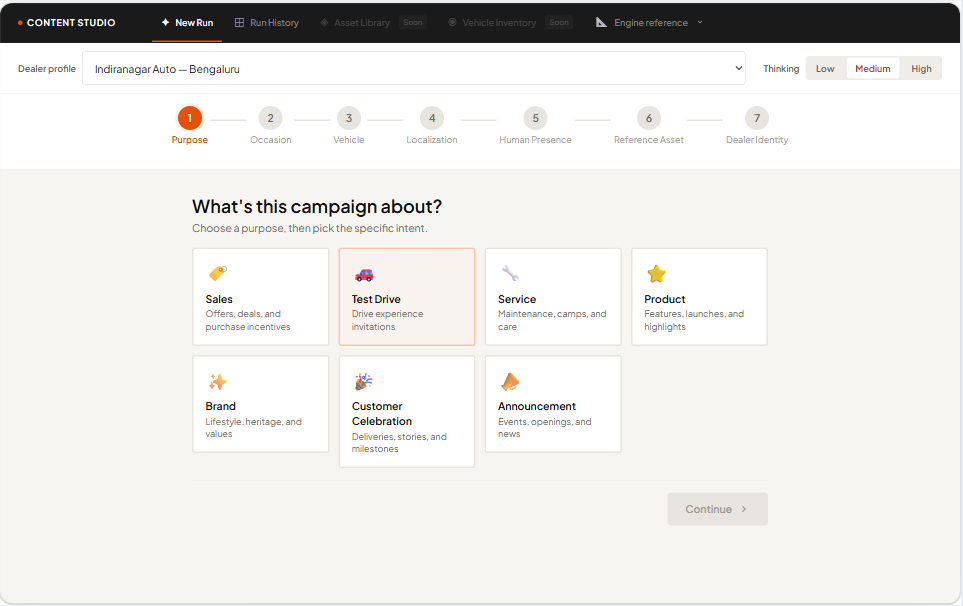
7-step structured input form
Dealer Input
7 structured fields. Purpose, occasion, vehicle, localization level, human presence, reference asset, dealer identity. No free text.
Reasoning Note
Before any creative output, the model reasons about buyer mindset, occasion context, and what the creative needs to accomplish.
Story Line Generation
3 story lines with different tonal anchors using the reasoning note as grounding.
Story Line Selection
Dealer picks one direction. Second and final human touchpoint.
Prompt Engineering
Translates selected story line into a structured image generation prompt. 1:1 format for social media.
Image Generation
Final creative rendered as a downloadable image. Stored in Postgres, not the filesystem.
This is a testing instrument, not a demo
Every design choice, run history, thinking traces, annotation panel, per-layer inspection, exists because the real goal is to test and tune the engine.
Structured input is a product lever
Constraining what the user can say improves what the model generates. Input structure matters as much as prompt engineering.
Reasoning before generation matters
Layer 2a before Layer 2b produces noticeably more grounded outputs than going straight to generation. Thinking budget size affects this.
The right human-in-the-loop moment
Story line selection, not image approval, is the right point to involve the human. Narrow enough to be useful, open enough that choice still matters.
What v2 would look like
Reference asset upload, multi-format output (1:1, 4:5, 16:9), and a scoring layer that evaluates creative-to-brief alignment before showing the dealer.
Full codebase, React frontend, Express backend, 5-layer pipeline, Railway deployment, built through Claude Code. Phase 9 complete.
Stack
Frontend
React + Vite
Plus Jakarta Sans
Backend
Node + Express
Async pipeline
Reasoning
Gemini 2.5 Flash
Thinking enabled
Image Gen
Gemini 2.0 Flash
Inline image
Database
PostgreSQL
Railway + SQLite local
Hosting
Railway
Frontend + Backend
Version Control
GitHub
main + dev
More AI Product Work
Case Study
AI Segmentation & Sentiment
NLP-based review segmentation and sentiment scoring shipped to enterprise clients.
Read Case Study →Case Study
AI Review Responder
AI-generated responses for customer reviews. TAT reduced from days to hours, response rate lifted from 50% to 80%.
Read Case Study →